
Palliative care
Health professionals are central to helping patients, families and carers understand their options, plan ahead and access the right support at the right time. This section brings together practical information, resources and referral pathways to support quality palliative and end-of-life care across our region.
Support at Home: End-of-Life Pathway
The End-of-Life Pathway supports older people who have been diagnosed with three months or less to live and wish to remain at home during the final stage of life.
Delivered under the Support at Home program, the pathway provides short-term funding for approved in-home aged care services, such as personal care, domestic assistance and nursing care, and is designed to complement state and territory palliative care services. Health professionals can support eligible patients by confirming eligibility, completing the End-of-Life Pathway form, including an Australian-modified Karnofsky Performance Status score, and helping patients, carers or providers submit the form through the appropriate My Aged Care pathway.
Greater Choices for At Home Palliative Care (GCfAHPC) Project
MPHN is one 31 PHN’s across the nation to receive funding to coordinate palliative care activities in their region.
The GCfAHPC identifies being cared for and dying at home is most people’s preference. This initiative aims to help make that possible by enhancing local service provision, to improve access to safe, quality palliative care at home and support end-of-life care systems and services in primary healthcare and community care.
Getting to the heart of it: Advance care planning in general practice
General practice is often where these conversations begin. Trusted, ongoing relationships with patients place primary care teams in a unique position to introduce advance care planning in a way that feels supportive and timely, not overwhelming.
To support this, ACPA has released a NEW Supporting ACP in general practice factsheet ahead of National Palliative Care Week. The factsheet provides clear guidance on how ACP conversations and activities align with existing processes and MBS items, showing that advance care planning is not an “add‑on”, but part of routine, high‑quality care.
National Consensus Statement: Peadiatric end of life care
The Australian Commission on Safety and Quality in Health Care has updated the National Consensus Statement: Essential elements for safe and high quality paediatric end of life care with the latest guidance for clinicians and health services.
The Consensus Statement describes how end-of-life care for a child should be approached and delivered effectively across healthcare settings.
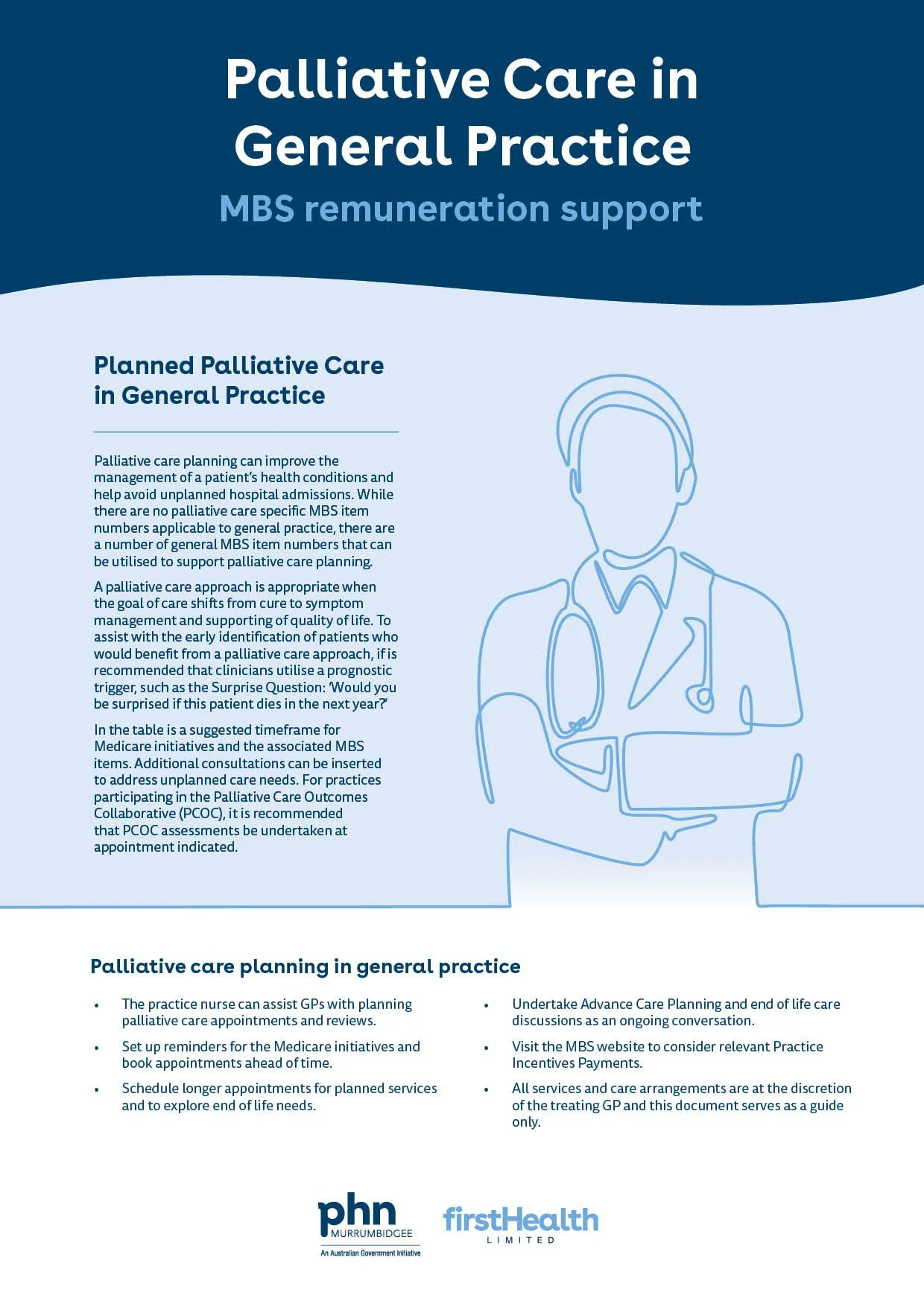
Palliative care in general practice
This practical resource supports GPs and practice teams to plan and coordinate palliative care for patients whose care goals are shifting from cure to symptom management and quality of life. It outlines how existing Medicare Benefits Schedule items may be used to support planned consultations, advance care planning, multidisciplinary care, medication reviews and ongoing monitoring.
The resource also includes a suggested 12-month appointment schedule, palliative care considerations and links to further clinical information. It is intended as a guide, with all services and care arrangements remaining at the discretion of the treating GP.
Resources
Multilingual ESAS-PCOC
The ESAS-PCOC is now available in 19 of the most commonly used community languages in palliative care, supporting more inclusive, culturally appropriate symptom assessment. Developed in partnership with the Multicultural Health Communication Service at NSW Health, this consumer-led initiative underwent a rigorous cultural validation process, alongside National Accreditation Authority for Translators and Interpreters (NAATI)-certified translation and independent review.
Palliative care education and training
Health professionals play an important role in recognising palliative care needs, coordinating care and supporting people with life-limiting illness, their families and carers.A range of free and paid education opportunities is available to help general practitioners and other health professionals strengthen their knowledge, skills and confidence in palliative and end-of-life care.
Find palliative care training
Australian Government palliative care education and training
The Australian Government maintains a national collection of free palliative care education and training opportunities for people working in primary care and aged care.The collection includes programs and resources covering communication, advance care planning, symptom management, culturally responsive care, aged care and end-of-life decision-making.
Visit the Australian Government palliative care education and training website:
https://www.health.gov.au/topics/palliative-care/palliative-care-education-and-training
View the education and training opportunities matrix:
https://www.health.gov.au/resources/publications/palliative-care-education-and-training-opportunities-for-anyone-who-works-in-primary-care-and-aged-care
CareSearch
CareSearch provides evidence-based palliative care information, clinical resources and education for Australian health professionals.Its General Practitioner Hub includes information about patient assessment, care planning, symptom management, clinical decision-making, caring for a dying patient, bereavement and professional practice.
Visit the CareSearch General Practitioner Hub:
https://www.caresearch.com.au/health-professionals/general-practitioner/
Explore ongoing education opportunities:
https://www.caresearch.com.au/health-professionals/general-practitioner/professional-practice/ongoing-education/
Explore short courses and workshops:
https://www.caresearch.com.au/health-professionals/health-practitioner-education/health-professional-options/short-courses-and-workshops/
RACGP aged care clinical guide
The Royal Australian College of General Practitioners’ aged care clinical guide, commonly known as the Silver Book, provides practical guidance for GPs caring for older people in the community and residential aged care.The palliative and end-of-life care chapter covers illness trajectories, advance care planning, symptom management, medication management, multidisciplinary care and support for patients, families and carers.
View the palliative and end-of-life care chapter:
https://www.racgp.org.au/clinical-resources/clinical-guidelines/key-racgp-guidelines/view-all-racgp-guidelines/silver-book/part-a/palliative-care
Free national education programs
-
The Program of Experience in the Palliative Approach, known as PEPA, provides free workshops, supervised placements and learning resources for health professionals. Opportunities are available across Australia, including for health professionals working in rural and remote communities.
PEPA also offers workshops specifically developed for GPs and other medical practitioners.
Visit PEPA: https://pepaeducation.com/
-
The Indigenous Program of Experience in the Palliative Approach, known as IPEPA, provides culturally responsive workshops, placements and learning resources.
IPEPA supports Aboriginal and Torres Strait Islander health professionals to build their palliative care capabilities and assists non-Indigenous health professionals to provide culturally safe and responsive care.
Visit IPEPA: https://pepaeducation.com/ipepa/
-
The Palliative Care Curriculum for Undergraduates provides learning resources that can be used by universities, vocational education providers, educators, students and health professionals.
Visit PCC4U: https://pcc4u.org.au/
-
The Advance Project provides free, evidence-based resources and training to help general practices, primary care services and aged care teams identify people who may benefit from advance care planning and palliative care.
Visit The Advance Project: https://www.theadvanceproject.com.au/
-
End-of-Life Essentials provides free online education for health professionals working in acute hospitals. Modules address recognising deterioration, communication, clinical decision-making, teamwork and patient-centred end-of-life care.
Visit End-of-Life Essentials: https://www.endoflifeessentials.com.au/
-
End of Life Law for Clinicians provides free online training about Australian laws relating to end-of-life decision-making. Modules cover capacity and consent, advance care planning, withholding and withdrawing treatment, substitute decision-making, medication and voluntary assisted dying.
Visit End of Life Law for Clinicians: https://end-of-life.qut.edu.au/
-
End of Life Directions for Aged Care, known as ELDAC, provides education, toolkits and resources to support high-quality palliative and end-of-life care for older Australians.
Visit ELDAC: https://www.eldac.com.au/
-
palliAGED provides evidence-based resources about palliative care for older people. Resources are available for GPs, nurses, allied health professionals, care workers, older people, families and carers.
Visit palliAGED: https://www.palliaged.com.au/
-
The Gwandalan National Palliative Care Project provides education and training materials to improve the cultural safety, accessibility and quality of palliative care for Aboriginal and Torres Strait Islander peoples.
Visit the Gwandalan project: https://gwandalanpalliativecare.com.au/
-
The Paediatric Palliative Care Education Hub provides online learning for health professionals caring for children and young people with life-limiting conditions.
Its courses include paediatric palliative care fundamentals, communication, end-of-life care and discipline-specific learning.
Visit the education hub: https://palliativecareeducation.com.au/?tenant=Paeds
Outcome measurement and quality improvement
-
The Palliative Care Outcomes Collaboration, known as PCOC, supports services to measure patient outcomes and use standardised assessment tools to improve palliative care.
Visit PCOC: https://www.pcoc.org.au/
Courses for general practitioners and rural generalists
-
The Australian College of Rural and Remote Medicine offers online palliative care courses through its learning platform.
Available courses include:
Palliative Care: A Doctor’s Bag
Palliative Care: Choose Your Own Journey
Search ACRRM online learning: https://mycollege.acrrm.org.au/search/find-online-learning
Course availability, fees and continuing professional development recognition should be confirmed directly with ACRRM before enrolment.
-
ACRRM’s Advanced Specialised Training in Palliative Care is a 12-month training option for rural generalists seeking advanced palliative care capabilities.
Learn more: https://www.acrrm.org.au/fellowship/discover-fellowship/ast/palliative-care-ast
-
Palliative care may be undertaken as an Additional Rural Skills Training discipline through the RACGP Rural Generalist Fellowship.
Training involves a minimum of 12 months full-time equivalent in an accredited training post.
Learn more about Additional Rural Skills Training: https://www.racgp.org.au/the-racgp/faculties/rural/rural-generalist-fellowship/arst-information-from-2022
-
The Rural and Remote Institute of Palliative Medicine supports doctors seeking palliative medicine training in rural and remote Australia.
Training pathways include:
the six-month Clinical Foundation in Palliative Medicine
12-month generalist training for GPs and rural generalists
three-year specialist advanced training in palliative medicine.
Visit the Rural and Remote Institute of Palliative Medicine: https://www.rripm.org.au/rural-training/
Formal qualifications and advanced training
-
The Royal Australasian College of Physicians’ Clinical Foundation in Palliative Medicine provides six months of full-time equivalent supervised clinical training in an accredited setting.
It is open to medical practitioners who want structured clinical experience in palliative medicine. Completion does not provide specialist recognition in palliative medicine.
Learn more: https://www.racp.edu.au/trainees/advanced-training/clinical-foundation-palliative-medicine
-
Doctors seeking specialist recognition in palliative medicine may complete the RACP Advanced Training program.
The program requires three years of supervised specialist training and workplace-based assessment.
Learn more: https://www.racp.edu.au/trainees/advanced-training/palliative-medicine
-
Flinders University offers short courses and postgraduate study in palliative and end-of-life care.
Short-course options may include:
Certificate in Palliative Care
Specialist Certificate in Palliative Care
Communication Skills for End-of-Life Conversations.
Visit Flinders University’s palliative care short courses:
https://www.flinders.edu.au/study/short-courses/palliative-care-short-coursesCourse dates, fees, entry requirements and availability should be confirmed directly with the education provider.
Prescribing and regulatory information
Some medicines used in palliative care are subject to additional prescribing, storage, supply or authority requirements.
NSW Health provides application forms and regulatory information for medical practitioners who need approval to prescribe or supply particular medicines.
Visit NSW Health pharmaceutical application forms:
https://www.health.nsw.gov.au/pharmaceutical/doctors/pages/application-forms.aspx
This information is regulatory guidance rather than a palliative care training program. Health professionals should confirm current requirements with NSW Health and consult relevant clinical guidance before prescribing.